
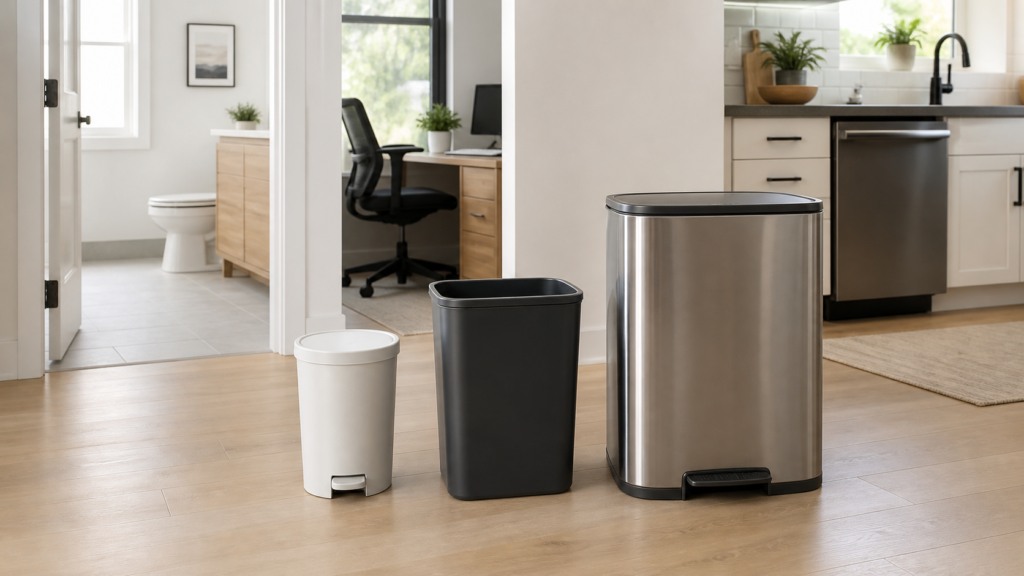
The right trash can size depends on more than the printed gallon number. Room, household size, cooking habits, emptying frequency, floor space, odor risk and bag fit all change what feels practical day to day.
How to choose a trash can: start with the room, then match capacity, footprint, lid style and bag fit. A kitchen usually needs more capacity and odor control; a bathroom or office usually needs a smaller can that is easy to empty; a tight cabinet or small kitchen needs measurements before brand choice.
If bag fit is already the problem, use the trash bag size calculator or the trash bag size chart. If placement is the problem, compare where to put a trash can in a small kitchen.
If you want the broader room-by-room context behind the recommendation, read the Trash Can Size by Room guide. If your main problem is odor rather than size, use the Trash Can Odor Diagnosis Checklist before replacing the can.
Already have the can and only need the liner? Use the Trash Bag Size Calculator after measuring the rim and height. Use this size selector when you are still deciding which trash can size belongs in the room.
Use this selector to get a starting size range and setup recommendation. It does not pick a specific product, and it should not replace measuring your space before buying. The goal is to prevent the most common mistake: choosing a can that is either too small to use or too large to empty before it smells.
Decision tool
Size Selector
Answer six quick questions to get a practical starting recommendation for capacity, shape, lid type, bag fit and the next guide to read.
- No product picks in this tool
- No prices or affiliate links
- Measure before buying
Why this fits
Check before buying
Before buying, check three things: the gallon range, the real floor or cabinet space, and the bag size you can buy easily. A can can be the right capacity and still be wrong if the lid hits a counter, the bag slips, or food waste sits too long.
For liner fit, use the trash bag size chart. For standard kitchen cans, check 13-gallon trash bag dimensions. For tight kitchens, compare where to put a trash can in a small kitchen.
How To Use The Result
Treat the result as a shortlist, not a final product pick. Before buying, measure the space where the can will sit, the height needed for the lid to open and the path for lifting a full bag out. A technically correct size can still be wrong if it blocks a dishwasher, cabinet door or walkway.
For kitchens, do not choose the biggest can by default. A larger can can reduce bag changes, but it can also hold food waste longer. If odor is already a problem, a smaller can emptied more often may work better than a larger can with a loose lid.
For bathrooms, bedrooms and offices, smaller bins usually work because most waste is dry. For garages and utility areas, the can may need more capacity, but sharp debris, heavy loads and outdoor storage change the bag and lid requirements.
Common Sizing Mistakes
- Choosing only by gallon size without checking height, rim width or cabinet clearance.
- Buying a large kitchen can that holds food waste too long.
- Using a liner that hangs above the bottom of the can.
- Putting a tall step can under a counter where the lid cannot open.
- Assuming an under-sink can solves odor, leaks or pet access by itself.
- Choosing a visible can for looks but ignoring bag-change clearance.
When To Read A More Specific Guide
If your main issue is smell, use the odor guides before assuming the trash can size is the problem. Odor often comes from food waste, liner leaks, lid residue or trash sitting too long.
After capacity, the next decision is usually placement, material or lid style. For visible kitchens, compare plastic vs stainless steel trash cans. For hands-free use, compare touchless vs step trash cans. For hidden bins, start with under-sink trash can size.
After choosing the can capacity, check the liner separately. Use what size trash bag fits my trash can if you know the can size but are not sure which bag capacity or dimensions will grip the rim correctly.
If your main issue is a small kitchen, compare placement and access before picking a can. A slim can, under-sink bin and pull-out cabinet can all work, but each one fails in a different way if the space is measured poorly.
If your main issue is leaking, check bag fit before upgrading to stronger bags. A bag that is too tight, too short or unsupported at the bottom can fail even when it is thick enough for normal kitchen trash.
Measure Before You Buy
Trash can labels are only a starting point. Before buying a bin, check the measurement that controls fit: cabinet clearance, lid swing, opening width, height under the counter, walkway clearance and bag overhang.
Trash Can Advisor gives practical buying guidance, not a guarantee that every brand or model will fit every space.
FAQ
Can this selector guarantee the perfect trash can?
No. It narrows the size range and buying route. Final fit still depends on your exact space, lid clearance, cabinet hardware, household habits and the model you choose.
What should I measure first?
Measure the available width, depth and height first. Then check lid opening clearance, bag removal path and whether the can blocks drawers, appliances or the main walkway.
When should I use the bag calculator instead?
Use the trash bag calculator when you already have a can and only need liner fit. Use this selector when you are still choosing the can itself.