
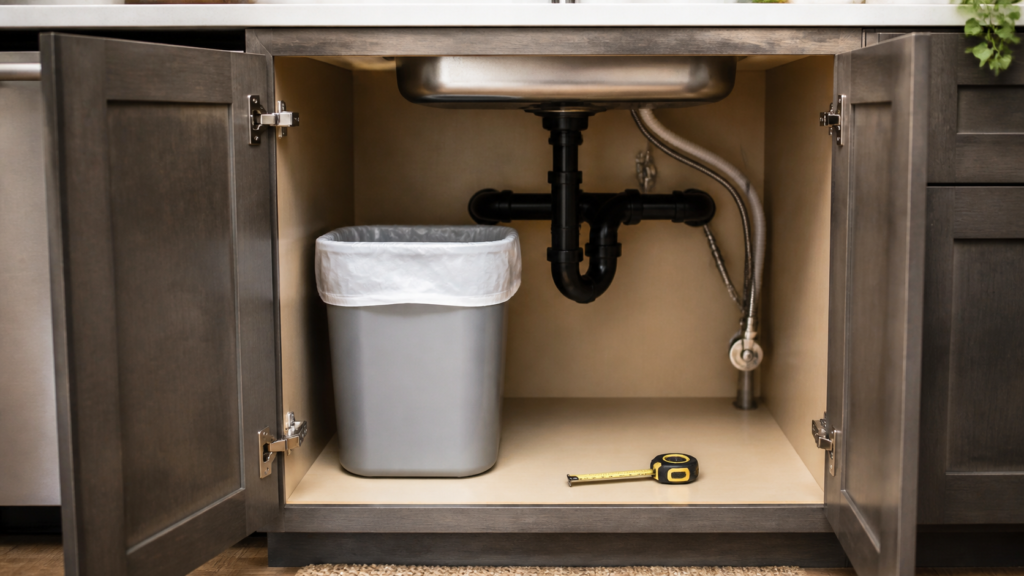
The safest under-sink trash can size for most kitchens is usually 5 to 10 gallons. A 7- to 10-gallon can is often the sweet spot if the cabinet has clean space around the plumbing. A 10- to 13-gallon can can work in some cabinets, but it becomes risky under a sink because the sink bowl, pipes, garbage disposal, hinges and lid clearance can steal more room than expected.
The important point is this: do not choose by gallons alone. Choose by the actual cabinet opening, usable depth, usable height and the space needed to remove a full bag without tearing it on plumbing.
If you already know the can capacity but need the right liner, use the trash bag size calculator after you measure. Under-sink bins are especially sensitive to bag fit because a loose bag can slide down, and an over-tight bag can tear when you pull it past pipes or rails.
Quick Under-Sink Trash Can Size Chart
| Trash Can Size | Best Use Under The Sink | Usually Works When | Main Risk |
|---|---|---|---|
| 2-4 gallons | Compost, bathroom-style waste, very small kitchens | You empty it often and need to dodge plumbing | Too small for normal kitchen trash |
| 5-7 gallons | Small under-sink kitchen bin | The cabinet is tight or shared with cleaning supplies | More frequent bag changes |
| 7-10 gallons | Most practical under-sink range | You have decent width, depth and height below the sink | May still fail around a disposal or deep sink bowl |
| 10-13 gallons | Large under-sink or dedicated pull-out setup | The cabinet is clean, deep and not crowded by plumbing | Often too tall, deep or awkward for a sink base |
| 13+ gallons | Usually better outside the sink cabinet | You have a dedicated pull-out cabinet, not a cramped sink base | Hard to fit, hard to remove, odor can build before emptying |
The Short Answer
For a normal kitchen sink cabinet, start your search in the 7- to 10-gallon range. Go smaller if the cabinet has a garbage disposal, low plumbing, shelves, a water filter or cleaning supplies you cannot move. Go larger only if you have measured the cabinet and confirmed the can can slide in, open and come back out with a full bag.
If the can will sit loose inside the cabinet, you can sometimes use a slightly taller or wider bin because you can angle it in and out by hand. If the can will sit on a pull-out frame, be stricter. The frame, rails, handle and mounting hardware all need space, and the required cabinet opening matters more than the printed gallon capacity.
Measure These 8 Things Before Buying
Under-sink cabinets are deceptive. The outside cabinet width may look generous, but the usable space can shrink quickly once the sink bowl, pipes, disposal and hinges are included.
- Cabinet opening width: measure the narrowest clear opening, not just the cabinet box.
- Inside cabinet width: measure side wall to side wall after hinges and obstructions.
- Usable depth: measure from the front frame to the first pipe, disposal or back-wall obstruction.
- Usable height: measure from the cabinet floor to the lowest sink bowl, pipe, shelf or disposal point.
- Door swing: confirm the door opens far enough to remove the bin or extend a pull-out.
- Lid travel: if the can has a lid, measure the height needed for the lid to open.
- Bag removal path: make sure a full bag can lift out without scraping a pipe or rail.
- Cleaning access: leave enough room to wipe leaks from the cabinet floor.
Leave at least 1 to 2 inches of clearance wherever possible. A bin that barely fits when empty can become annoying when the bag is full, wet, heavy or bulging.
Loose Bin Vs Pull-Out Trash Can
A loose under-sink bin is the simplest setup. It is usually best when your cabinet is irregular, the plumbing is awkward or you rent and want to avoid drilling into the cabinet. The downside is that you have to pull the bin out by hand, and it can slide around if the cabinet floor is smooth.
If you are still choosing the layout, compare under-sink trash cans vs slim step cans. If the cabinet is narrow, move next to the narrow pull-out trash can fit guide instead of guessing from gallon size alone.
A pull-out trash can is cleaner to use when it fits properly. It slides forward on rails, which makes daily access easier and keeps the bin in a fixed position. The tradeoff is measurement. A pull-out frame can fail even when the bin itself looks small enough because the rails and mounting hardware need width and depth.
| Setup | Best For | Measurement Priority | Watch Out For |
|---|---|---|---|
| Loose bin | Renters, awkward plumbing, quick setup | Bin width, depth, height and bag removal | Sliding, tipping, hidden leaks |
| Door-mounted bin | Very small trash, compost, light use | Door strength, hinge clearance, lid clearance | Too much weight on the cabinet door |
| Pull-out frame | Cleaner daily access and fixed placement | Required cabinet opening, frame depth, rail travel | Plumbing, disposal and door clearance |
If your under-sink space uses a pull-out frame, treat it as a cabinet-fit problem before you choose by gallons. First check the full pull-out trash can cabinet dimensions guide, then compare the narrow-fit guides for a 12-inch cabinet or 15-inch cabinet. A bin can be the right gallon size and still fail because the rails, lid, plumbing or bag-removal path need more clearance.
What Fits In A 12-Inch Or 15-Inch Cabinet?
Many pull-out trash systems are sold around cabinet opening width, especially 12-inch and 15-inch setups. Do not assume a “12-inch cabinet” means you have 12 inches of clear usable space. Face frames, hinges and product rails can reduce the real opening.
As a practical rule, a narrow 12-inch opening usually points toward a single small bin or a compact pull-out frame. A 15-inch base cabinet gives you more options and may support a larger single bin, but plumbing can still break the fit if the cabinet is under the sink.
If your cabinet is dedicated to trash, use the dedicated pull-out cabinet dimensions guidance below. If the cabinet is directly under the sink, stay conservative and measure around the plumbing first.
How Much Capacity Do You Actually Need?
Capacity depends on how your household uses the kitchen. A small household that cooks lightly may be fine with 5 to 7 gallons under the sink. A household that cooks daily, uses takeout packaging or throws food scraps into the main trash may want 10 gallons or more, but that does not mean the sink cabinet is the best place for it.
In many kitchens, a smaller under-sink bin works better because it forces more frequent emptying. That can reduce odor and stop wet trash from sitting inside a closed cabinet too long. If you hate changing bags often, a larger freestanding step can may be more practical than forcing a big bin under the sink.
For a direct comparison between hidden and visible setups, see under-sink vs slim step trash can.
Lids, Odor And Bag Fit
A lid can help contain smell, but it also makes fit harder. A hinged lid needs opening height. A swing lid needs room to move. A removable lid needs enough clearance for your hand and the bag. In a low under-sink cabinet, a lid can turn a good-looking bin into a daily annoyance.
Odor is not solved by hiding the bin. Under-sink placement can make the kitchen look cleaner, but it can also hide leaks and damp residue until they smell worse. If odor is already the problem, read how to keep a trash can from smelling and how to clean a trash can before buying a larger hidden bin.
Bag fit also matters more under the sink. If the liner is too small, it can stretch and tear when you pull it past pipes. If it is too large, it may bunch up and slide down. Once you know the can size and shape, use the trash bag size calculator to choose a better liner range.
Common Mistakes
- Buying by gallons only: two 10-gallon cans can have very different widths, depths and heights.
- Ignoring the garbage disposal: it can block the exact space where the bin needs to sit.
- Forgetting lid clearance: a lidded bin may fit closed but fail when opened.
- Not testing bag removal: the can may fit, but the full bag may catch on plumbing.
- Overfilling a small bin: compact bins work best when emptied before the bag bulges.
- Installing a pull-out in a rental: drilled hardware can create lease problems unless approved.
Best Starting Point
If you want the safest first choice, look for a simple 7- to 10-gallon rectangular bin and compare its exact width, depth and height against your cabinet measurements. If your cabinet is crowded, drop to 5 to 7 gallons. If your cabinet is clean and you want a rail system, measure the opening and depth before looking at gallon capacity.
The right under-sink trash can is not the biggest one that can be shoved into the cabinet. It is the one you can open, empty, clean and reline without fighting the plumbing every day.
FAQ
Is a 13-gallon trash can too big for under the sink?
Often, yes. A 13-gallon can can fit in some clean base cabinets, but it is frequently too tall, deep or awkward for a real sink cabinet with plumbing and a disposal. Measure before assuming a standard kitchen can will work.
What is the best gallon size for an under-sink kitchen trash can?
For most kitchens, 7 to 10 gallons is the best starting range. Smaller cabinets may need 5 to 7 gallons. Larger capacities are possible, but they need cleaner cabinet space and more careful measurement.
Can I use a pull-out trash can under the sink?
Yes, if the cabinet has enough clear width, depth and height for the frame, rails, bin and plumbing. Pull-out systems need stricter measurement than loose bins because the hardware has to move freely.
Should an under-sink trash can have a lid?
A lid can help with odor, but only if it has enough room to open and does not make bag changes harder. In very tight cabinets, an open bin that you empty frequently may work better than a lidded bin that is annoying to use.
How much clearance should I leave around an under-sink trash can?
Leave at least 1 to 2 inches where possible, and more above the can if it has a lid. Also check the path for removing a full bag, not just the empty-bin fit.