
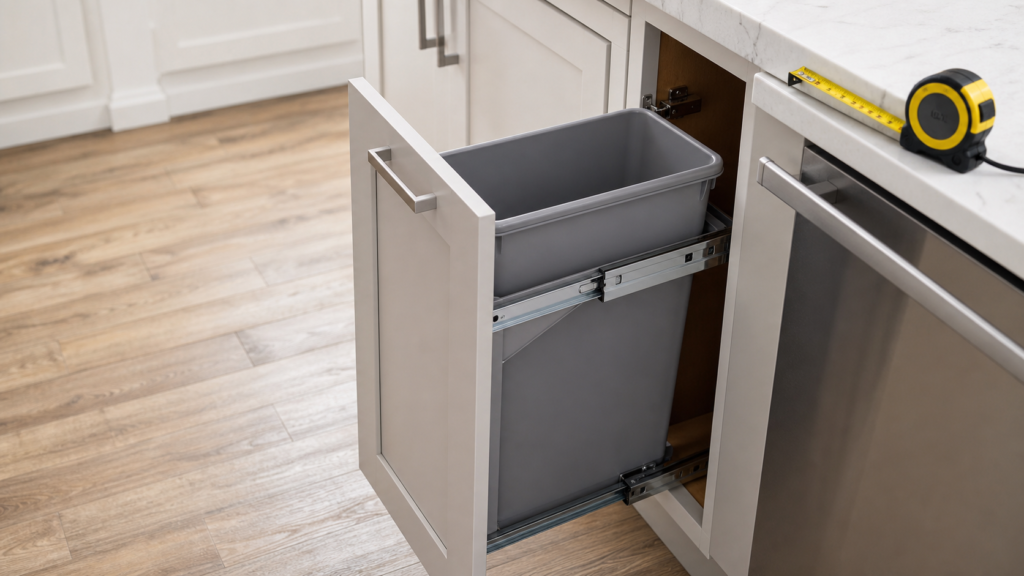
A 12-inch cabinet can fit a pull-out trash can, but it is one of the tighter cabinet sizes. The phrase “12-inch cabinet” is only a starting point. What matters is the clear opening inside the cabinet after the face frame, hinges, door hardware and any obstructions are accounted for.
In most cases, a 12-inch base cabinet points toward a narrow single-bin pull-out, not a large kitchen trash setup and not a comfortable trash-and-recycling system. It can still be useful if you want hidden daily trash in a small kitchen, but the margin for measurement mistakes is small.
If you have not measured the cabinet yet, start with the broader pull-out trash can cabinet dimensions guide. This page focuses specifically on the 12-inch cabinet problem.
The Short Answer
For a 12-inch cabinet, look for a narrow single-bin pull-out system and compare the product’s minimum cabinet opening with your real clear opening. Do not buy by gallons first. A bin that sounds small enough can still fail because the frame, rails, handle, door mount or full bag needs more room than the empty container.
If the cabinet is under the sink, be even more conservative. Plumbing, a garbage disposal, water filters, supply lines or a deep sink bowl can turn an otherwise usable cabinet into a bad pull-out location.
12-Inch Cabinet Fit Reality
A nominal 12-inch cabinet is narrow. In a frameless cabinet, the usable opening may be closer to the cabinet label. In a face-frame cabinet, the clear opening can be meaningfully smaller because the frame overlaps the front of the cabinet. Hinges and door hardware can reduce the usable path even more.
This is why product pages often refer to a minimum cabinet opening rather than only a cabinet width. The minimum opening is the number you should treat as the hard filter. If your measured opening barely clears the requirement, the installation may technically fit but still feel tight every time you pull the bin out or remove a full bag.
Measure These Points Before Shopping
- Clear opening width: measure the narrowest front opening, not just the cabinet label.
- Inside width: measure the floor area where the pull-out frame will sit.
- Usable depth: measure from the front opening to the back wall or first obstruction.
- Usable height: measure from the cabinet floor to the lowest shelf, drawer, pipe or sink bowl.
- Door swing: confirm the cabinet door opens far enough for the pull-out to extend.
- Hinge position: check whether hinges reduce the clear path of the frame or handle.
- Rail travel: make sure the bin can slide out far enough to lift the bag cleanly.
- Bag removal path: test the vertical space a full bag needs, not only the empty bin.
- Under-sink obstructions: if applicable, map the disposal, P-trap, supply lines and filters.
Write these measurements down before comparing products. A narrow pull-out can look correct in a product photo but still fail because the cabinet opening is slightly smaller than expected.
What Usually Fits In A 12-Inch Cabinet?
The most realistic setup is a compact single-bin pull-out. This can work well for a small household, apartment kitchen, secondary trash location, island cabinet or light daily waste. It is also useful when the main goal is to hide a small trash can rather than maximize capacity.
The tradeoff is volume. A narrow bin fills faster, and bulky packaging can be annoying. If you cook often, use large food packaging or want one main kitchen trash can for a family, a 12-inch pull-out may feel undersized unless recycling and overflow trash live somewhere else.
What Usually Does Not Fit Well?
A 12-inch cabinet is usually a poor match for a generous dual-bin trash-and-recycling setup. Two bins inside a narrow opening often means both bins are small, so the system can become more frustrating than useful. It may look tidy, but if both sides fill quickly, the hidden setup stops feeling convenient.
Large 13-gallon-style kitchen capacity is also difficult in many 12-inch cabinets. Some narrow rectangular bins can use space efficiently, but the cabinet still needs room for the frame, rails and bag removal. Capacity alone does not prove fit.
Extra Warning For Under-Sink 12-Inch Cabinets
A 12-inch cabinet under the sink is a higher-risk installation than a clean base cabinet. The usable space may be interrupted by plumbing at exactly the height or depth where the pull-out needs to travel.
Before buying, open the cabinet and imagine the full movement: the frame slides forward, the bin rises slightly as you lift it, and a full bag may bulge wider than the empty bin. If any pipe, disposal unit, filter or sink bowl blocks that path, choose a smaller loose bin or a different location. The under-sink trash can size guide covers those sink-base constraints in more detail.
Bag Size And Capacity Tradeoffs
Small pull-out bins can be awkward with standard kitchen bags if the bag is too loose, too tall or too tight around a rectangular rim. A poor liner fit can collapse into the bin, bunch at the rails or make the already-small capacity feel worse.
Once you know the bin dimensions, use the trash bag size calculator to estimate a better liner fit. For narrow pull-outs, the best bag is not always the largest bag. It is the bag that grips the rim, reaches the bottom and can be removed without tearing against the frame.
When A 12-Inch Pull-Out Is A Bad Idea
A pull-out frame is not always the right answer. If the cabinet is rented, irregular, badly out of square, crowded with plumbing or too shallow, a simple loose bin may be safer. You lose the smooth slide-out action, but you avoid drilling, alignment problems and a system that scrapes every day.
If the 12-inch cabinet is your only open waste location and you need more capacity, compare the hidden pull-out idea with a slim freestanding can. The guide on under-sink vs slim step trash cans can help with that tradeoff, and the small-kitchen placement guide may reveal a better spot: where to put a trash can in a small kitchen.
Common 12-Inch Cabinet Mistakes
- Trusting the cabinet label: 12 inches outside does not mean 12 inches of clear opening.
- Ignoring face frames: face-frame cabinets can reduce the path the frame must pass through.
- Buying by capacity first: gallons do not tell you whether the pull-out frame fits.
- Forgetting the handle: a handle can hit the opposite door or reduce clearance.
- Skipping bag removal: the bin may fit closed but still be painful to empty.
- Trying to force dual bins: two tiny bins can be less useful than one compact bin.
- Underestimating sink plumbing: pipes and disposal units often steal the exact space a pull-out needs.
A 12-inch cabinet is a narrow-fit decision, not just a capacity decision. If your opening is tight, use the narrow pull-out trash can checklist to avoid rail, lid and bag-removal problems. If your measured opening is closer to 15 inches, compare the 15-inch cabinet fit guide before settling for a smaller bin.
Best Next Step
Measure the clear opening, usable depth and usable height first. Then compare those numbers with the minimum cabinet opening and installed dimensions in the product specification. If the product barely fits on paper, choose a smaller unit or a different trash location.
The best 12-inch cabinet setup is usually a narrow single-bin pull-out that moves smoothly and empties easily. A slightly smaller system that works every day is better than a larger one that catches on the frame, rubs the door or makes every bag change annoying.
FAQ
Can a pull-out trash can fit in a 12-inch cabinet?
Yes, some narrow single-bin pull-out trash cans can fit in a 12-inch cabinet, but only if the clear opening, depth, height and rail path match the product requirements.
Is a 12-inch cabinet big enough for kitchen trash?
It can be big enough for light daily kitchen trash or a small household, but it may feel too small for heavy cooking, bulky packaging or a family that wants one main kitchen trash can.
Can I fit trash and recycling in a 12-inch pull-out cabinet?
Usually not comfortably. A 12-inch cabinet is generally better for one compact bin. Dual-bin systems in very narrow spaces often create two bins that fill too quickly.
What should I measure for a 12-inch pull-out trash can?
Measure the clear opening width, inside width, usable depth, usable height, hinge clearance, door swing, rail travel and bag removal path. For sink-base cabinets, also measure around plumbing and disposal units.
Should I choose a pull-out or a loose bin for a 12-inch cabinet?
Choose a pull-out if the cabinet is clean, square and large enough for the frame. Choose a loose bin if the space is irregular, rented, crowded with plumbing or too tight for smooth rail movement.