
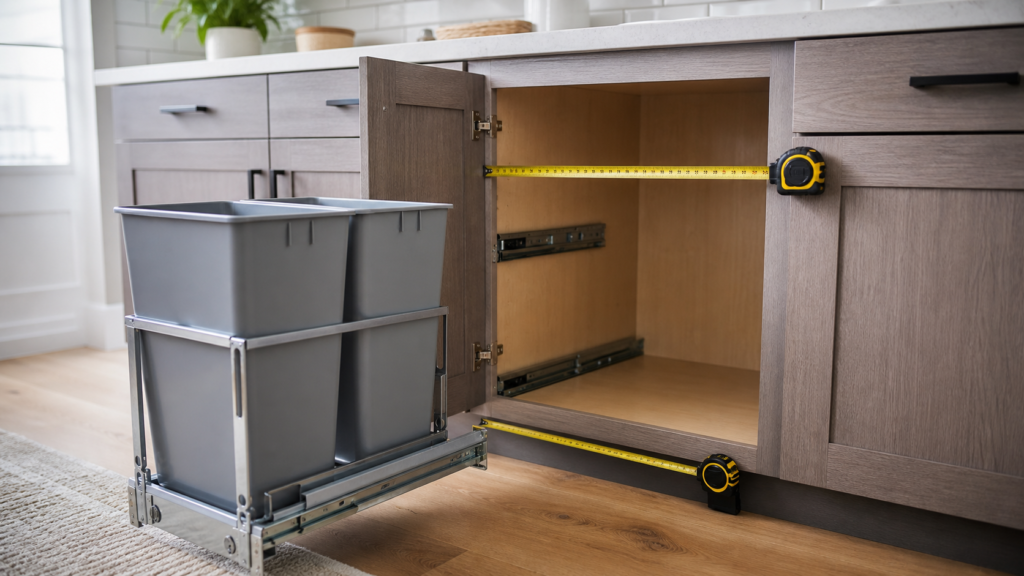
The most important pull-out trash can dimension is not the gallon capacity. It is the minimum cabinet opening the frame needs to slide, mount and clear the door. A bin may look small enough, but the rails, frame, handle, door brackets and full bag removal path can make it fail inside the cabinet.
As a practical starting point, 12-inch cabinets usually fit narrow single-bin systems, 15-inch cabinets are a common single-bin pull-out range, 18-inch cabinets give more comfortable options, and 24-inch cabinets are better for larger trash-and-recycling setups. Those are starting points, not promises. You still need to measure the real opening, usable depth and usable height.
If your pull-out will go directly under the sink, read the under-sink trash can size guide too. Sink-base cabinets are harder because plumbing, disposal units, water filters and deep sink bowls can steal the exact space the pull-out frame needs.
Fast sizing rule: measure the clear cabinet opening first, then check installed depth, usable height, rail travel and the path for lifting out a full bag. A 12-inch cabinet usually means a narrow single-bin setup, a 15-inch cabinet is the common single-bin range, and 18- to 24-inch cabinets open up larger or dual-bin systems. If the cabinet is under a sink, also check the under-sink trash can size guide because plumbing can block a pull-out that would fit in a clean base cabinet.
For exact narrow-cabinet decisions, compare the dedicated 12-inch cabinet and 15-inch cabinet fit guides before buying.
Fast answer: for a pull-out garbage or trash can, start with the cabinet opening, not the can’s gallon capacity. A 12-inch cabinet usually points to a narrow single-bin frame, 15 inches is a common single-bin range, 18 inches gives more comfortable trash capacity, and 24 inches is where larger trash-and-recycling pull-outs become realistic.
Before buying, measure clear opening width, usable depth, usable height, slide travel and the path for removing a full bag. If the unit goes under the sink, leave extra room for plumbing and compare the under-sink trash can size guide before treating any product listing as a guaranteed fit.
Quick Cabinet Dimension Chart
| Nominal Cabinet Width | Likely Pull-Out Setup | Best Use | Main Fit Risk |
|---|---|---|---|
| 12 inches | Narrow single bin or compact frame | Small kitchens, tight base cabinets, light trash use | Face frame and hinges reducing the real opening |
| 15 inches | Common single-bin pull-out range | Everyday kitchen trash when space is limited | Frame depth, handle clearance and bag removal |
| 18 inches | Larger single bin or compact dual-bin system | Trash plus recycling or larger household use | Door mounting and rail travel alignment |
| 24 inches | Larger dual-bin trash and recycling system | Dedicated waste cabinet, recycling-heavy kitchen | Losing too much cabinet storage to one system |
This table is useful for narrowing the search, but it should not replace the product specification sheet. A “15-inch cabinet” label does not guarantee 15 inches of usable opening. A face-frame cabinet, a thick door, an uneven opening or a hinge can reduce the space enough to matter.
The Short Answer
Measure your cabinet before comparing products. The four dimensions that matter most are clear opening width, usable depth, usable height and rail travel. Then compare those numbers with the product’s minimum cabinet opening and installed dimensions.
If your cabinet barely meets the minimum opening, treat it as a risk. Pull-out trash cans need enough tolerance for mounting screws, slide alignment, door brackets, the handle, bag overhang and a full bag that may bulge wider than the empty bin.
Measure These 9 Points First
- Clear opening width: measure the narrowest point between the frame, hinges or door hardware.
- Inside cabinet width: measure side wall to side wall where the frame will sit.
- Usable depth: measure from the front opening to the back wall or the first obstruction.
- Usable height: measure from the cabinet floor to the lowest shelf, drawer, sink bowl, pipe or disposal.
- Door swing: confirm the door opens far enough for the frame to extend.
- Rail travel: check how far the unit must slide out for the bin to lift cleanly.
- Door-mount space: if the cabinet door attaches to the pull-out, leave room for brackets and adjustment.
- Handle clearance: make sure the pull handle does not hit the opposite door or frame.
- Bag removal path: confirm a full bag can lift out without catching on the counter, drawer, rail or plumbing.
Write the numbers down before shopping. Product listings can mix bin size, frame size and cabinet-opening requirements, and those are not the same thing.
Minimum Opening Vs Cabinet Width
Cabinet width is the label. Minimum opening is the real installation requirement. A cabinet sold as 15 inches wide may have less clear space once the face frame and door hardware are included. Frameless cabinets often give a cleaner opening, while face-frame cabinets need more careful measurement.
Use the minimum opening as the first filter, then check depth and height. Do not buy a pull-out system because the bin capacity sounds right. A 35-quart bin and another 35-quart bin can have different frame widths, depths and rail designs.
12-Inch Pull-Out Trash Can Cabinets
A 12-inch cabinet is a narrow route. It usually points toward a single compact bin, not a generous trash-and-recycling system. It can work well in a small kitchen, but only if the opening is truly clear and the frame does not rub the door or face frame.
This size is most useful when you want hidden daily trash and you are willing to empty it more often. If you cook heavily or want one main kitchen trash can, a 12-inch cabinet may feel too small unless the rest of your waste setup is efficient.
15-Inch Pull-Out Trash Can Cabinets
A 15-inch cabinet is one of the more practical starting points for a single-bin pull-out. It gives more room for a usable kitchen-trash capacity while still fitting into many small kitchen layouts.
The mistake is assuming 15 inches solves everything. Check the installed depth and handle position. A deeper frame may hit plumbing, a back wall, a shelf or stored supplies. If the door mounts to the pull-out, alignment also matters because a slightly crooked install can make the door rub.
18-Inch And 24-Inch Cabinets
An 18-inch cabinet opens up more comfortable single-bin systems and some compact dual-bin options. This is often where trash plus recycling becomes realistic without fighting the cabinet every day.
A 24-inch cabinet is usually better for larger dual-bin systems, but it is also a bigger commitment. Before using that much cabinet space, decide whether you actually want trash and recycling hidden together or whether one stream should live somewhere else. A large pull-out that blocks access to cleaning supplies can solve one problem while creating another.
Extra Warning For Sink-Base Cabinets
Under-sink pull-outs are more difficult than clean base-cabinet pull-outs. The cabinet may be wide enough on paper, but the disposal, P-trap, water lines, filters or sink bowl can block the frame or the bin when it slides forward.
If the cabinet is under the sink, measure the path the frame will travel, not only the resting position. A pull-out can fit when closed and still fail when extended because it hits plumbing or cannot lift the bag out cleanly.
Door Mount, Rails And Bag Clearance
Many pull-out trash systems can be used with a cabinet door attached to the front. That can look cleaner, but it adds another measurement layer. The brackets need adjustment room, the door needs to sit square, and the slides need to carry the door without rubbing.
Full-extension slides are usually more convenient because the bin comes farther out of the cabinet. Partial-extension designs can still work, but bag changes may be more awkward. If the bin does not clear the cabinet enough, a full liner can scrape the frame or tear as you lift it.
After you choose the can size, use the trash bag size calculator to avoid another common failure: a liner that is too tight for a rectangular pull-out bin or so loose that it collapses into the trash.
Loose Bin Vs Pull-Out Frame
A pull-out frame is not always the better choice. If your cabinet is irregular, rented, crowded with plumbing or hard to drill cleanly, a loose bin may be safer and cheaper. You lose the smooth slide-out movement, but you gain flexibility.
If a slide-out frame is too deep or too permanent for the cabinet, compare it with the cabinet door trash can size guide. A door-mounted bin solves a different fit problem: door strength, swing path, inside clearance and small-bin bag removal.
For a small kitchen layout decision, compare this page with under-sink vs slim step trash can and where to put a trash can in a small kitchen. Sometimes the best answer is not a hidden pull-out; it is a slim freestanding can in a better location.
Common Pull-Out Dimension Mistakes
- Buying by gallons: capacity does not tell you the frame width, depth or installed clearance.
- Measuring the cabinet label: the nominal cabinet width is not always the clear opening.
- Ignoring the face frame: face-frame cabinets can steal width right where the rails need to pass.
- Forgetting the handle: the handle may hit the opposite door or reduce usable depth.
- Skipping bag removal: the bin may fit, but a full bag may not lift out cleanly.
- Installing under plumbing without testing travel: the frame needs to move, not just sit inside the cabinet.
- Choosing dual bins too early: two small bins can be annoying if both fill quickly.
If the cabinet is narrow, do not stop at the general dimension chart. Use the narrow pull-out trash can checklist to check width, depth, lid clearance and bag removal together. For exact-width decisions, compare the dedicated 12-inch cabinet fit and 15-inch cabinet fit guides before choosing a product.
Best Starting Point
If you have a clean base cabinet, start by filtering products by the measured minimum opening, then compare installed depth and height. If you have a 12-inch cabinet, expect a narrow single-bin solution. If you have a 15-inch cabinet, a practical single-bin pull-out becomes more realistic. If you have 18 or 24 inches, decide whether trash plus recycling is worth the cabinet space.
If the cabinet is under the sink, stay more conservative. A slightly smaller pull-out that works smoothly is better than a larger system that technically fits but catches on pipes, rubs the door or makes every bag change irritating.
For product selection later, this page can support a buying guide for small-cabinet under-sink trash cans. For now, use it as a measurement checklist before buying anything.
FAQ
What cabinet size do I need for a pull-out trash can?
Many pull-out trash cans are designed around 12-inch, 15-inch, 18-inch or 24-inch base cabinets, but the real requirement is the product’s minimum cabinet opening. Measure the clear opening, depth and height before choosing.
Will a 13-gallon trash can fit in a pull-out cabinet?
Sometimes, but do not judge by gallons alone. A 13-gallon bin needs enough cabinet width, depth, height, rail clearance and bag removal space. It is more realistic in a clean base cabinet than in a crowded sink-base cabinet.
Can a pull-out trash can fit under the sink?
Yes, but it is riskier than installing one in a clean base cabinet. Plumbing, disposal units, water filters and sink bowls can block the frame or the bag-removal path.
Is a 12-inch cabinet too small for a pull-out trash can?
Not always. A 12-inch cabinet can work for a narrow single-bin pull-out, but it is usually too tight for a generous trash-and-recycling setup. Measure the clear opening carefully.
How much clearance should I leave for a pull-out trash can?
Use the manufacturer’s minimum opening as the hard floor, then leave extra room where possible for installation tolerance, rails, door brackets, handle clearance and bag removal.