
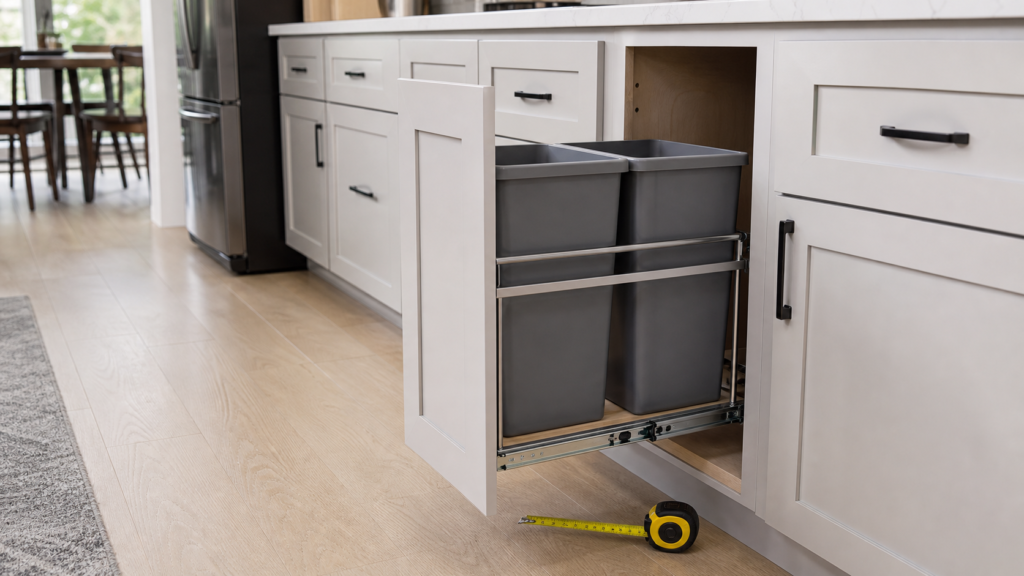
A 15-inch cabinet is one of the more practical sizes for a pull-out trash can. It often gives enough room for a useful single-bin setup while still fitting into a small or space-conscious kitchen. But it is not automatic. A cabinet labeled 15 inches can still have a smaller clear opening once the face frame, hinges, door hardware and installation tolerances are included.
The safe approach is simple: measure the cabinet first, then compare your numbers with the product’s minimum cabinet opening and installed dimensions. Do not choose by gallon capacity alone.
If you need the broader measurement process first, use the pull-out trash can cabinet dimensions guide. This page focuses on the 15-inch cabinet decision.
Fast answer: a 15-inch cabinet can often fit a useful single-bin pull-out trash can, but the cabinet label is not enough. Confirm the clear opening, usable depth, usable height, slide travel, handle clearance and the path for lifting out a full bag.
If the cabinet is under the sink, be more conservative because plumbing, a disposal, water filters or a deep sink bowl can block a frame that would fit in a normal base cabinet. Start with the full pull-out cabinet dimensions guide, then compare the under-sink trash can size guide and the 12-inch cabinet fit guide if your opening is tight.
| 15-inch cabinet setup | Usually safest when | Main fit risk |
|---|---|---|
| Single pull-out bin | The opening, depth and height meet the frame specs with room for bag removal. | Rails or face-frame loss make the real opening tighter than expected. |
| Compact dual-bin pull-out | Trash volume is light and recycling separation matters more than capacity. | Each bin may be too small for daily kitchen trash. |
| Under-sink pull-out | Plumbing and disposal clearance have been measured with the slide extended. | A pipe, filter or sink bowl blocks rail travel or full-bag removal. |
The Short Answer
A 15-inch cabinet can often fit a practical single-bin pull-out trash can. Some compact dual-bin systems may also fit, but they usually trade capacity for separation. For most small kitchens, one well-sized bin in a 15-inch pull-out is more useful than two tiny bins that fill too fast.
Before buying, confirm the clear opening width, usable depth, usable height, rail travel, handle clearance and bag removal path. If the pull-out will sit under a sink, also measure around plumbing and disposal units.
Why 15 Inches Is Useful, But Not Guaranteed
Compared with a 12-inch cabinet, a 15-inch cabinet gives more room for a bin that feels realistic for daily kitchen trash. It can be a good fit for apartments, smaller kitchens, islands, pantry-base cabinets and households that want trash hidden without dedicating a wider cabinet.
The trap is assuming the label solves the fit. In a face-frame cabinet, the front opening can be narrower than the inside cabinet box. In a frameless cabinet, you may get a cleaner opening, but hinges, door movement and rail alignment can still matter. Product minimum-opening specs are more important than the cabinet label.
Measure These Points Before Shopping
- Clear opening width: measure the narrowest point the pull-out frame must pass through.
- Inside cabinet width: measure the floor space where the frame mounts.
- Usable depth: measure to the back wall, shelf, pipe or first obstruction.
- Usable height: measure from the cabinet floor to the lowest obstruction above the bin.
- Face-frame loss: note whether the front frame reduces the usable opening.
- Hinge clearance: check if hinges or door hardware interfere with the slide path.
- Door-mount space: if the cabinet door attaches to the pull-out, leave room for brackets and alignment.
- Rail travel: make sure the bin extends far enough to remove the bag cleanly.
- Bag removal path: check the space needed for a full bag, not just the empty bin.
Single Bin Vs Dual Bin In A 15-Inch Cabinet
A single-bin pull-out is usually the cleaner choice for a 15-inch cabinet. It gives more usable trash capacity, fewer bag changes and less daily friction. If the cabinet is meant to be the main kitchen trash location, start with the single-bin assumption.
A compact dual-bin setup can make sense if your trash volume is light and you strongly want trash and recycling hidden together. The tradeoff is that each bin will be smaller. If both bins fill quickly, the dual-bin setup may feel organized in theory but annoying in practice.
Capacity And Bag Fit
Capacity numbers can be misleading because pull-out bins are often narrow and rectangular. A bin may hold enough volume on paper but still be awkward if the liner collapses, stretches too tightly or catches on the frame during removal.
Once you know the actual bin width, depth and height, use the trash bag size calculator to estimate a better liner fit. For a cabinet pull-out, a good bag needs enough overhang to grip the rim but not so much loose plastic that it bunches near the rails.
Under-Sink 15-Inch Cabinets Need Extra Caution
A clean 15-inch base cabinet is very different from a 15-inch sink-base section. Under the sink, plumbing can steal depth, height and rail travel. A garbage disposal, P-trap, water filter, supply line or deep sink bowl can block the frame or prevent the bag from lifting out cleanly.
If the pull-out will go under the sink, read the under-sink trash can size guide before buying. Measure the full slide path, not only the closed position. A system that fits when shut can still fail when extended.
Door Mount, Rails And Handle Clearance
Many pull-out trash systems can attach to the cabinet door. This looks cleaner because opening the door pulls the bin out with it, but it adds another fit layer. The brackets need adjustment space, the door needs to sit square, and the slide system needs to move without rubbing the face frame.
Full-extension slides are usually easier to live with because the bin comes farther out for bag changes. Partial-extension designs may still work, but they can make a narrow cabinet feel tighter. In a 15-inch cabinet, convenience often depends on how easily the full bag clears the cabinet front.
When To Choose A Different Setup
Choose a different setup if your measured opening is barely above the minimum, the cabinet is crowded with plumbing, or you need more capacity than one narrow pull-out can realistically provide. A slim freestanding can may be more practical than forcing a hidden system into a bad location.
For small kitchens, compare the pull-out idea with under-sink vs slim step trash cans and where to put a trash can in a small kitchen. The best waste setup is the one you can use comfortably every day, not the one that only looks clean in a product photo.
Common 15-Inch Cabinet Mistakes
- Assuming all 15-inch products fit: minimum opening and installed dimensions still vary.
- Choosing dual bins too quickly: two small bins may be less useful than one larger bin.
- Ignoring face-frame loss: the front opening can be narrower than the cabinet box.
- Forgetting door-mount hardware: brackets and alignment need room.
- Measuring only the closed position: the frame also needs to slide and the bag needs to lift out.
- Buying by gallons: capacity does not prove the frame, rails or bag path will work.
- Treating under-sink space as normal cabinet space: plumbing changes the entire fit calculation.
For narrow or borderline cabinets, check the full fit path before buying. The narrow pull-out trash can guide helps you compare frame width, depth, lid clearance and bag removal. If your clear opening is much tighter than expected, use the 12-inch cabinet guide as the conservative fallback.
Best Starting Point
For a 15-inch cabinet, start with a single-bin pull-out unless you have a strong reason to split trash and recycling. Then filter products by the measured clear opening, usable depth and usable height. If the product barely fits, choose a smaller frame or another location.
A 15-inch pull-out can be a very useful hidden trash setup when the measurements are right. The goal is not to force the largest possible bin into the cabinet. The goal is a bin that slides smoothly, holds enough for your household and lets you remove the bag without fighting the cabinet.
FAQ
Can a pull-out trash can fit in a 15-inch cabinet?
Yes, many 15-inch cabinets can fit a practical pull-out trash can, especially a single-bin system. The final answer depends on the clear opening, depth, height and product minimum cabinet opening.
Is a 15-inch cabinet enough for a kitchen trash can?
Often, yes. A 15-inch cabinet can be enough for a compact main kitchen trash setup, but heavy households or recycling-heavy kitchens may need a wider cabinet or a separate recycling location.
Can I use a double pull-out trash can in a 15-inch cabinet?
Sometimes, but expect smaller bins. A double setup may work for light trash and recycling, but one larger single bin is usually more convenient for main kitchen trash.
What is the most important measurement for a 15-inch pull-out?
The clear cabinet opening is the first filter, but depth, height, rail travel and bag removal space matter too. For under-sink locations, plumbing clearance can be the deciding factor.
Should I choose a 15-inch pull-out or a slim step trash can?
Choose the pull-out if the cabinet has enough clear space and you want hidden trash. Choose a slim step can if the cabinet is too tight, under-sink space is crowded or you need easier capacity and bag changes.